







Introduction
In an increasingly crowded digital marketplace, local businesses must fight for visibility — not only through compelling services or products, but through impeccable online presentation. One of the most fundamental yet often overlooked foundations of local SEO is the consistency of your NAP — Name, Address, and Phone number — across every directory, listing, and platform where your business appears.
Your Google Business Profile (GBP) is likely your most visible online “storefront,” appearing in Google Search, Google Maps, and the Local Pack. But GBP alone is not enough. If your business information is inconsistent across dozens of other directories — social media profiles, Yelp, Yellow Pages, local business directories, niche review sites, blog mentions, etc. — search engines may struggle to verify your legitimacy. That leads to diminished trust signals, lower rankings, scattered citation authority, and ultimately fewer customers finding you.
This comprehensive guide dives deep into the why, what, and how of NAP consistency: why it matters, how to audit and enforce it, what workflows and tools help, how to coordinate with GBP and other directories, and how to future-proof your local SEO presence.
- Understanding NAP Consistency and Its Role in Local SEO
1.1 What is NAP
- N stands for Business Name.
- A stands for Physical Address (street, suite/unit, city, state, ZIP — or equivalent for non-U.S. countries).
- P stands for Phone Number (typically the primary business phone).
When we say “NAP consistency,” we mean that the same exact combination (or canonical version) of these three elements appears across all online references of your business — your website, review sites, social media pages, local directories, citation sites, and your GBP profile.
From a technical SEO perspective, NAP entries must be crawlable text (not embedded only in images), and ideally also included in structured data (e.g. schema markup) on your website — so search engines can read and index them properly.
1.2 Why NAP Consistency Matters — For SEO and Users
1.2.1 For Search Engines: Trust, Verification, and Ranking
- Digital identity verification: Search engines use repeated NAP matches across multiple independent sites/dirs as a signal that your business is legitimate, stable, and located where you say it is.
- Ranking factor for local search: Local SEO algorithms — including those that determine who appears in the Local Pack or on Google Maps — rely on citations and NAP consistency as a core trust and relevance signal.
- Preventing citation fragmentation: When the same business appears under different NAP variants (e.g. “St.” vs “Street”, or “Suite 200” vs “#200”), search engines may treat them as separate businesses. The result: your citation “juice” gets diluted instead of concentrated.
1.2.2 For Users: Trust, Accuracy, and Experience
- Avoid confusion and frustration: Customers using directories, search engines, social media, or maps expect to see consistent contact information. If they see different addresses or phone numbers, they may doubt your legitimacy.
- Reliable conversions: Whether they’re calling, mapping directions, or visiting — consistent NAP ensures they end up at the right place and reach the right business, boosting the likelihood of conversion.
1.2.3 Long-term business benefits
- Stronger local brand authority: Uniform NAP across many directories builds a solid foundation for being seen as a stable, established business.
- Easier reputation and review management: When all listings point to the same canonical business identity, reviews, backlinks, and citations aggregate properly — improving local SEO equity over time.
- Lower maintenance overhead (with proper regime): Once you establish a canonical NAP format and use it consistently, future updates (e.g. phone number change, address change) become systematic and manageable.
As one succinct summary puts it: NAP consistency is “your business’s digital identity card.”
- Common NAP Pitfalls — What Typically Goes Wrong
Even well-intentioned business owners slip here. Some of the most frequent issues:
- Name variations: Using different versions of the business name across listings, e.g. “My Business LLC”, “MyBusiness”, “My Business, Inc.”, “My Business – Detroit”, or adding unnecessary keywords (e.g. “Best Pizza Detroit”) can fragment your identity.
- Address formatting differences: For instance, “123 Main St.” in one directory, “123 Main Street” in another; missing suite/unit numbers; different uses of abbreviations like “Rd.” vs. “Road,” “Ave” vs. “Avenue,” and inconsistent punctuation or spacing.
- Phone number discrepancies: Using different phone numbers (e.g. toll-free vs. local), changing number formatting (parentheses, dashes, international vs. local format), or neglecting to include area code in some listings.
- Missing or inconsistent data across platforms: For example, having the NAP correct on your website and GBP, but outdated or incorrect on lesser-known directories, social media, or industry-specific review sites.
- Multiple (duplicate) listings: Sometimes businesses end up with multiple profiles on the same directory — e.g. two GBP entries, two Yelp entries — each with slight variations; this splits reviews, citation strength, and undermines clarity.
- Neglecting structured data / schema: Some businesses list their address only in images or text that’s difficult for search engines to crawl; missing or inconsistent structured data can hamper proper indexing.
- How NAP Consistency Impacts Your Google Business Profile (GBP)
Because GBP tends to be the single-most prominent public listing for many local businesses, its interaction with NAP consistency deserves special attention.
3.1 GBP as the “anchor” of your local presence
Your GBP listing often appears at the top of search results, in Google Maps, and in the Local Pack. When the NAP in GBP matches what’s on your website and other directories, it acts as a strong anchor — bolstering Google’s confidence in your business data.
When NAP is consistent across your own website, major directories, and GBP — search engines are more likely to attribute citations, reviews, and links back to one unified entity rather than scattering them across variants.
3.2 Risks of mismatched GBP vs other listings
- Suppression or duplicate detection: If GBP detects conflicting information (e.g. different address or phone number than other sources), it may suppress or merge listings — potentially removing visibility.
- Loss of “Local Pack” eligibility: Inconsistency erodes one of the key trust signals for local ranking (citations + NAP + proximity + relevance + prominence). Without clean NAP, your business may struggle to appear in map results, even if other factors (like reviews) are strong.
- Poor user experience leads to lower behavioral signals: If users click on your GBP listing and see conflicting address/phone info, they may bounce, call the wrong number, or abandon — all of which negatively impact user behavior signals, relevant for ranking.
3.3 The reality: GBP + directories + citations = a “web ecosystem”
Your GBP profile doesn’t exist in a vacuum — it is part of a broader web ecosystem consisting of your website, social profiles, directory listings, citation sites, review sites, and more. Search engines cross-reference all these for consistency and verification. In this context, NAP consistency becomes a foundational requirement, not an optional “nice to have.”
- Auditing Your NAP: A Step-by-Step Workflow
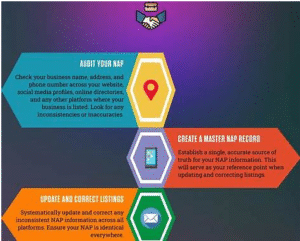
Before you can enforce consistency, you must first know what’s out there. Here’s a structured workflow that many local-SEO professionals use to audit NAP across the web — often in under an hour to start.
4.1 Step 1: Define your canonical NAP format
Create a small internal “style guide” document that defines exactly how your business name, address, and phone number should appear. For example:
| Element | Canonical Format Example |
| Business Name | Acme Plumbing LLC (vs “Acme Plumbing”, “Acme Plumbing & Heating”, “Acme Plumbing, Inc.”) |
| Address | 123 Main Street, Suite 200, Detroit, MI 48000 (vs “123 Main St. #200”, or “123 Main St., Detroit, MI” etc.) |
| Phone Number | (810) 555-1234 (area code + parentheses + dash) — choose one format and stick to it |
Having a canonical format ensures that everyone on your marketing/management team uses the exact same version. This prevents accidental variants cropping up over time.
4.2 Step 2: Inventory existing listings and citations
- Search manually: Use queries like “Your Business Name” + phone number, or “Your Business Name” + address, or “Your Business Name” + city to find directories, review sites, and mentions.
- Use tools: There are specialized tools and platforms (see Section 6) to scan the web and compile a list of listings and citations.
- Document everything: Use a spreadsheet (or database) to record each listing, URL, the NAP as it appears, date found, notes (e.g. misspellings, missing suite number, phone difference, etc.).
This inventory will give you the baseline — once you have it, you’ll know where inconsistencies exist.
4.3 Step 3: Prioritize critical listings
Not all directories and listings carry equal weight. For efficiency, prioritize:
- Your own website (header, footer, contact page, about page)
- GBP / Maps listing
- Major directory sites (Yelp, BBB, industry-relevant directories)
- High-traffic citation sites / review platforms
- Social media profiles (Facebook, LinkedIn, Instagram, etc.)
- Niche or lesser-known directories
Fixing the top group first ensures that the most influential NAP entries are corrected immediately, which has the biggest impact.
4.4 Step 4: Claim, Correct, and Consolidate Listings
- Claim listings: On directories where your business has unclaimed or unverified listings, claim them — this helps ensure you can control and edit details.
- Correct NAP entries: For listings under your control, update the NAP to match the canonical version.
- Request edits or removal: On directories you don’t control (or where a listing seems redundant/duplicate), request edits or even removal to avoid mismatches.
- Consolidate duplicates: If there are multiple listings for the same business, merge them wherever possible — especially on high-value directories.
4.5 Step 5: Add structured data / schema markup on your website
Make sure your website has structured data (e.g. using JSON-LD) that declares your business name, full address, phone number, etc. This helps search engines parse and recognize your canonical NAP more reliably.
4.6 Step 6: Set up a recurring audit schedule
NAP consistency is not a one-time exercise. Directories get updated, new duplicates can appear, or third parties may create outdated listings. Create a recurring audit schedule (e.g., quarterly or bi-annually) to re-scan your listings and ensure everything remains aligned.
- Strategic Best Practices & Advanced Tips
Once you have the basics — canonical NAP, clean listings, structured data — you can optimize further with these strategic practices.
5.1 Use a centralized documentation + workflow
Maintain an internal document (e.g. Google Sheet, Airtable, Notion) listing all known directories where your business appears (claimed or unclaimed), their login/claim status, the date last reviewed, and current NAP status. Share this with everyone on your team responsible for marketing, customer service, or directory management.
This ensures that when someone creates a new directory listing — for example, for a new location — they refer to the canonical NAP and avoid creating inconsistent variants.
5.2 Use reputable listing-management tools
When manually auditing dozens of directories becomes too cumbersome, leverage SaaS tools / platforms that specialize in listing management, citation building, and NAP syndication. Many of these tools allow you to update your NAP once and push the update across many directories automatically (or semi-automatically).
They also often provide reporting dashboards, alerts for inconsistent or duplicate listings, and allow you to manage multiple locations (if you have a multi-site business).
5.3 Monitor for unauthorized or auto-generated listings
Sometimes third-party websites or aggregators auto-generate business listings (based on public records, data-scraping, or user submissions). These can pop up without your knowledge, often with incomplete or incorrect NAP.
As part of your recurring audit, look for:
- old/closed locations still listed,
- duplicate entries under slightly different variants,
- third-party data brokers or scrapers republishing your info with errors.
Claim or suppress those to avoid confusion or citation dilution.
5.4 Coordinate NAP updates with business changes
If you change your business phone number, move to a new address, rebrand, or open a new physical location — treat NAP update as a global change: update your canonical format first, then push updates across all listings, and document the change.
Having a workflow and central documentation makes this far more manageable and reduces the risk of inconsistent, outdated listings lingering online.
5.5 Leverage structured data beyond the basics
In addition to Name, Address, Phone (the core NAP), you can — and should — include additional business information in structured data:
- business hours / opening hours
- website URL
- service area (if relevant)
- business categories / types
- geo-coordinates (latitude, longitude)
These help search engines better understand and display your business — especially for voice search, mapping, and rich result features.
5.6 Use NAP consistency as the foundation for broader reputation management
NAP consistency doesn’t stand alone — it supports better review consolidation, link building, directory authority, and local branding. Once you have a clean foundation, you can layer on strategies such as: Google reviews, local content creation, local link building, social media campaigns, etc., with confidence that citation signals won’t fragment your authority.
- Tools & Resources for Managing NAP Consistency
Here are some recommended tools and resources — from DIY to professional-grade — to help manage, audit, and synchronize your NAP across the web:
| Tool/Resource Type | What It Helps With |
| Listing management platforms / SaaS (e.g. directory syndication) | Bulk update NAP across numerous directories, automate pushes when info changes, monitor listings and duplicates over time |
| Citation audit tools / scan tools | Discover all current citations of your business across the web (claimed & unclaimed) and highlight inconsistencies or duplicates |
| Spreadsheet / internal docs | Maintain canonical NAP record, track claimed listings, store login credentials, document update history, schedule audits |
| Structured data/schema markup tools | Generate correct JSON-LD or microdata for your website’s contact page / footer to help search engines parse info |
| Manual search & verification (quarterly) | Search for business name + phone/address to catch unexpected third-party or old listings; double-check high-value directories |
| Review & reputation platforms | Once NAP is consistent, you can aggregate reviews and reputation signals more reliably under your canonical business identity |
(If you like — I can compile a ready-to-use checklist + CSV template for GBP + NAP auditing that you can immediately plug into your business workflow.)
- Example: NAP Consistency in Action — A Hypothetical Local Business
To make this less abstract, here’s an example based on a fictional local business, showing “before” and “after” of NAP cleanup + synchronization, along with visual workflow and potential impact metrics.
7.1 Scenario setup
Business: Joe’s Coffee & Cafe
Canonical NAP:
- Name: Joe’s Coffee & Cafe
- Address: 456 Maple Avenue, Suite 101, Clinton Township, MI 48036
- Phone: (586) 123-4567
Initial problems discovered via audit:
- On GBP: Shows “Joe’s Coffee Café” (accent over “e”), address as “456 Maple Ave., Clinton Twp., MI 48036”, no suite number.
- On Yelp: “Joes Coffee & Cafe” (missing apostrophe), address “456 Maple Ave, Clinton Township, MI 48036”, phone listed as (586) 1234567.
- On Facebook: Old phone number (586) 999-0000 (previous office line), address correct but uses “#101” instead of “Suite 101”.
- On a local directory: duplicated listing “Joe’s Coffee and Cafe”, address “456 Maple Avenue, Clinton Township MI”, no suite.
- On the website: footer shows correct phone and address, but contact page uses “456 Maple Ave., Clinton Twp.”
Result: multiple variants of business identity scattered across web.
7.2 Cleanup process (workflow)
- Document canonical NAP (as above).
- Claim all listings (GBP, Yelp, Facebook, directory, local directory).
- Correct all NAP entries — unify business name, address (full street, suite), phone format.
- Request removal or merge of duplicate entries on directory with redundant listing.
- Update website contact page and footer to canonical NAP; embed structured data (JSON-LD) with correct info.
- After 7 days, recrawl by search engines; use citation audit tool to verify no new duplicates.
- Schedule quarterly check — next one in 3 months.
7.3 Expected/Observed Outcomes
| Metric / Outcome | Change / Improvement |
| Google Maps / Local Pack visibility | From unranked or low visibility → first page Local Pack for “coffee near Clinton Township MI” |
| Phone call conversions | Increase (customers more reliably reaching correct phone) |
| Foot traffic | More consistent because address + suite number clarity increased trust / reduced confusion |
| Review consolidation | All reviews now associated with correct listing (no split between variants) |
| SEO authority / citations strength | Citation signals concentrated, fewer duplicates, easier future link-building / local SEO efforts |
This example demonstrates how even small discrepancies — apostrophe, suite number, “Ave.” vs “Avenue” — can fragment your business’s digital presence, and how a systematic cleanup can deliver real improvement.
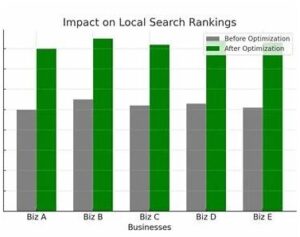
- Charting the Impact: Why NAP Consistency Should Be Part of Every SEO Strategy
To further illustrate the impact of NAP consistency, below is a conceptual chart showing how a “NAP audit & clean-up” can gradually improve local visibility, trust signals, and conversions over time.
- Integrating NAP Consistency into a Broader GBP / Local SEO Strategy
While NAP consistency is foundational, it works best when paired with other elements of a robust local SEO strategy. Here are some recommendations for integration:
- GBP optimization: Ensure GBP is fully filled out — with categories, business hours, photos, business description, services, attributes. NAP consistency complements and strengthens the rest of GBP data.
- Local content and citations: Once NAP is clean, publish local content (blog posts, news, community involvement) that references your business name + address — each becomes a citation opportunity that reinforces your identity.
- Reviews and reputation management: Encourage customers to leave reviews on your canonical listings. Because all variants match, reviews aggregate properly — boosting social proof and local ranking signals.
- Local link-building: Partner with local organizations, directories, or blogs for backlinks — with correct NAP presence on those pages for further citation strength.
- Multi-location or service-area businesses: If you have multiple branches or serve a wide area, maintain accuracy for each location — each with its own canonical NAP. Use proper service-area settings in GBP if applicable.
By building NAP consistency into your standard operating procedures, you make it part of the DNA of all future marketing, listing, and directory efforts.
- Challenges & How to Overcome Them
Maintaining NAP consistency over time isn’t always easy. Here are common challenges and strategies to overcome them:
10.1 Challenge: Auto-generated or third-party directories
Problem: Some directory sites auto-scrape public data or accept user submissions — they might produce outdated or duplicate listings without your knowledge.
Solution: Include these in your regular audit schedule. Use search queries with your business name and old/alternate phone numbers to find unexpected variants. Claim them — or, if possible, request edits or removal.
10.2 Challenge: Multiple team members / locations leading to inconsistency
Problem: When multiple people manage your online presence (e.g. marketing team, franchise locations), different variants can creep in.
Solution: Maintain and enforce a central canonical NAP style guide/document. Use shared documentation (e.g. Google Sheet, Airtable) that everyone must reference before adding or updating listings.
10.3 Challenge: Business changes (rebranding, moving location, new phone number)
Problem: When business information changes (address, phone, business name), updating everywhere manually is tedious and error-prone.
Solution: Treat NAP change as a project. First update canonical NAP, then push to all listings via management tools or manually, track each change, and re-audit after completion.
10.4 Challenge: Time and resource limitations
Problem: For small businesses, maintaining NAP consistency across dozens of directories may feel overwhelming.
Solution: Focus on high-impact directories (website, GBP, top directories) first. Use listing-management tools (see Section 6) to automate or streamline updates. Schedule audits quarterly or semi-annually rather than randomly.
10.5 Challenge: Structured data errors or missing schema
Problem: Even if your visible NAP is correct, missing or incorrect schema markup can prevent search engines from properly indexing your contact info.
Solution: Use validated JSON-LD markup on your website’s contact page/footer. Use testing tools (e.g. Google’s Rich Results Test) to verify correctness.
Remaining Thoughts
NAP consistency may seem like basic housekeeping — but in the world of local SEO, it’s more like the foundation of a house. Without it, everything built on top (citations, backlinks, reviews, Google Business Profile visibility, local content, branding) is precarious and fragmented.
By adopting a canonical NAP format, auditing diligently, consolidating listings, using structured data, and building workflows to maintain consistency — you strengthen your business’s digital identity. The payoff isn’t just better rankings in local search and Google Maps; it’s improved credibility, trust, user experience, and ultimately more real-world customers walking through your door or calling you.
For small businesses, multi-location enterprises, or anyone serious about local presence — NAP consistency is not optional. It’s essential.