







Table of Contents
- Introduction — The Local SEO Battlefield in 2026
- What Is NAP (and NAP Consistency)?
- Why NAP Consistency Still Reigns Supreme in 2026
- How Search Engines Use NAP: The “Relevance – Proximity – Prominence” Model
- The Hidden Costs of Inconsistent NAP — Loss, Confusion, Missed Opportunities
- Conducting a Thorough NAP Audit: A Step-by-Step Workflow
- Tools & Strategies to Maintain NAP Consistency at Scale
- Layering NAP Consistency with GBP Optimization, Reviews, and Structured Data
- Preparing for the Next Frontier: Voice, AI, and Predictive Search
- Realistic 2026 Case Studies & Before/After Scenarios
- Maintenance Best Practices & Organizational Policies
- Common Mistakes, Pitfalls & How to Avoid Them
- Conclusion — NAP Consistency as Your Foundation for Local Domination
- FAQ
- Introduction — The Local SEO Battlefield in 2026

In 2026, local search is more competitive than ever. More small businesses — from plumbers to boutique retail stores — recognize that their online presence is often their first (and only) interaction with potential customers. With the saturated digital marketplace and evolving technologies like AI-powered search, voice assistants, and hyperlocal targeting, the difference between being found or being invisible often boils down to one deceptively simple factor: consistency.
That’s where NAP consistency comes in. While many business owners and marketers chase flashy SEO strategies — creating content, building backlinks, optimizing for keywords — the foundational signals hold the real power. Without a consistent, accurate “digital identity,” even the most aggressive marketing campaigns may fall flat.
In this blog, we’ll show you why NAP consistency remains the secret weapon for dominating your Google Business Profile (GBP) rankings — and how getting it right in 2026 can make the difference between barely being found and owning your local search territory.
- What Is NAP (and NAP Consistency)?
Defining NAP
- N — Name of your business.
- A — Address (physical / mailing address).
- P — Phone number (ideally your primary contact number).
NAP consistency refers to using the exact same business name, address, and phone number — with the same formatting — across every online presence: your website, GBP, social profiles, directories, review sites, local citations, and more.
Think of NAP as your business’s “digital fingerprint.” Every time your business appears online, that fingerprint needs to match — otherwise, search engines and users may treat those listings as belonging to different businesses.
Why “Consistency” — Not Just “Accuracy”
Accuracy matters — you don’t want to mis-spell your street name, for example. But consistency means using the same spelling, abbreviations, and format everywhere. For instance: choose between “St.” vs “Street,” include suite numbers or not, and stick with it across all platforms.
Some may argue that minor differences (like “St.” vs “Street”) should be fine, but in practice, even small variations can cause fragmentation, especially across dozens of directories and citations.
- Why NAP Consistency Still Reigns Supreme in 2026
Even as SEO evolves and new ranking factors emerge, NAP consistency remains foundational. Here’s why:
- Trust & Legitimacy Signals: Consistent NAP across many sources tells search engines your business is real, stable, and maintained.
- Citation Power: Local directories, niche platforms, social media profiles, and third-party sites that list your business act as “citations.” When those all reflect identical NAP details, they add cumulative authority.
- Visibility in Map Pack / Local Pack: For a business to show up in the coveted “Map Pack” (the top 3-4 businesses next to the map), consistent NAP is a key signal among others.
- User Experience & Conversion: Inaccurate or conflicting info frustrates customers — wrong phone number, outdated address, or multiple variants may kill conversion. Consistent NAP ensures users can call, visit, or trust your business confidently.
- Foundation for Other Signals: Without a stable NAP, other ranking elements like reviews, structured data, even backlinks may lose context or potency. A messy foundation undercuts the rest.
In short: NAP consistency isn’t a “nice to have.” It’s the foundation. Without it, no amount of backlinks, content, or ads will reliably lift you in local search — especially in 2026, where competition and algorithm sophistication are higher than ever.
- How Search Engines Use NAP: The “Relevance – Proximity – Prominence” Model
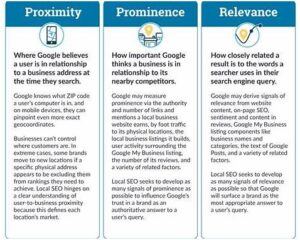
To understand why NAP consistency is so powerful, it helps to frame local search ranking through the classic triad many SEO pros reference: Relevance, Proximity, and Prominence.
- Relevance — how well your business matches the user’s search intent.
- Proximity — how geographically close your business is to the searcher (or the location specified).
- Prominence — how well-known or authoritative your business appears to be (based on citations, reviews, mentions, backlinks, etc.).
Where NAP Fits In
- Proximity: the address from your NAP defines where Google pins you on the map. A consistent, correct address ensures you show up for nearby searches.
- Prominence: consistent NAP across many directories and citations builds a web of evidence — a credible footprint that signals authority and legitimacy.
- Relevance: while NAP doesn’t directly affect whether you’re topically relevant (that’s content/backlinks), having clear and accurate NAP means you avoid confusion or mis-classification which could hamper relevance signals.
Because NAP consistency supports all three legs of the stool, it’s not an optional add-on — it’s central to whether you’ll even be considered by the algorithm for top local visibility.
- The Hidden Costs of Inconsistent NAP — Loss, Confusion, Missed Opportunities


Many businesses undervalue the real, tangible costs that come from inconsistent NAP — but those costs aren’t just theoretical. They translate directly into lost rankings, wasted marketing effort, and lost customers. Some of the most common consequences include:
- Citation Dilution / Fragmented Authority
When your name or address is written in multiple variants (e.g., “Main St.” vs “Main Street”, or “ABC LLC” vs “ABC Company”), search engines and directories may treat them as separate entities. That splits your citations and reviews across different “versions” — diluting overall authority rather than concentrating it. - Suppressed or De-prioritized Listings
Search engines may ignore or downgrade listings that seem inconsistent, outdated, or incorrect. That means even if you have many citations, they might not all count — or count as strongly — when evaluating your business’s prominence. - Poor User Experience → Lost Leads
A wrong phone number, wrong suite number, inconsistent formatting — any mismatch can frustrate a user. They might call the wrong number, go to the wrong address, or simply abandon the search and choose a competitor. That translates into lost conversions and damaged reputation. - Wasted Effort on Other SEO Tactics
You might build backlinks, optimize content, or even run ads — but if your foundational NAP is inconsistent, those efforts may not yield the expected benefit. It’s like building a skyscraper on a shaky foundation. - Difficulty Scaling — Especially for Multi-Location or Franchise Businesses
The more locations you have, the more likely inconsistencies creep in — especially if different staff manage listings. Without an organized NAP system, that growth can come back to haunt you.
- Conducting a Thorough NAP Audit: A Step-by-Step Workflow
If you suspect your NAP is inconsistent — or simply want to make sure it’s airtight — here’s a detailed workflow to conduct a comprehensive NAP audit:
Step 1: Choose & Define Your Canonical NAP Format
Before anything else, decide exactly how your business should appear. This is your “master NAP.” For example:
- Business name: “ABC Plumbing & Heating LLC”
- Address: “1234 Main Street, Suite 200, Detroit, MI 48226”
- Phone: “(313) 555-1234”
Write it down, save it in a central file (e.g. a shared Google Doc), and treat it as the source of truth going forward.
Step 2: Inventory All Online Listings & Citations
Create a spreadsheet with columns like:
| Platform / Directory | Current Name | Address | Phone | Notes / Issues |
Search for your business name, and also run variations (e.g. with and without abbreviations, with different phone formatting). Include:
- GBP / Google Maps listing
- Website (home page, footer, contact page)
- Social media pages (Facebook, Instagram, LinkedIn, etc.)
- Major directories (Yelp, Bing Places, Apple Maps, Yellow Pages, BBB, etc.)
- Niche / industry-specific directories & review sites
- Local blogs / news sites / chamber of commerce listings / guest articles
This step reveals where inconsistencies exist — and where you need to intervene.
Step 3: Prioritize Key Listings & Claim Where Needed
Not all listings are equal. Begin with the most impactful: your GBP, your website, major directories (Google, Bing, Apple, Yelp), high-authority local directories. Fix those first.
If a listing isn’t claimed or verified, take the time to claim it — verification is often necessary for making edits.
Step 4: Standardize & Update Listings
Using your canonical NAP, update each listing manually (or via bulk tools) so they exactly match.
- Use the same name, address format (street abbreviations, suite numbers, punctuation), phone format.
- Ensure your website’s footer, contact page, and any structured data / schema markup reflect the same NAP.
Step 5: Track Changes & Monitor Progress
Maintain your spreadsheet as a living document. After edits, go back in a few days/weeks to ensure updates have been applied (some directories take time to refresh).
Schedule periodic re-audits (quarterly or bi-annually) to catch drift — especially if business details change (new phone number, relocated office, new branch, etc.).
Step 6: Document Responsibility & Workflow
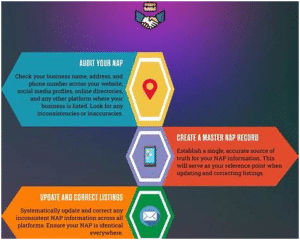
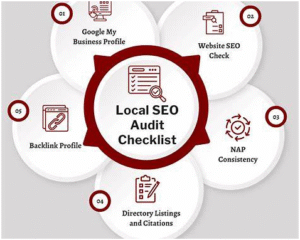
Assign clear responsibility: one person (or team) should own NAP management. That ensures consistency remains a priority and avoids chaos over time.
- Tools & Strategies to Maintain NAP Consistency at Scale
Manually auditing and updating dozens (or hundreds) of business listings can get overwhelming. Fortunately, there are tools and strategies to make NAP consistency scalable — especially for businesses with multiple locations or heavy citation footprints.
| Strategy / Tool | Benefit |
| Use citation management platforms (e.g. BrightLocal, Moz Local, or similar) | Automate detection of inconsistent NAPs across many directories; simplified bulk edits. |
| Maintain canonical NAP in a shared, version-controlled document | Single source of truth avoids confusion and internal drift. |
| Use structured data / schema markup on your website (e.g. LocalBusiness schema) | Makes it easier for search engines to crawl and interpret your NAP in a structured, machine-readable format. |
| Quarterly (or semi-annual) NAP audits | Proactive monitoring ensures NAP remains consistent, even as business details evolve. |
| Assign a “NAP owner” — internal or external | Ensures accountability; avoids “everyone thinks someone else is handling it.” |
Pro tip: For multi-location businesses (chains, franchises, local branches), treat each location as a separate “entity” — with its own canonical NAP, audit spreadsheet, and owner. The complexity increases with scale, but with systems in place, it remains manageable.
- Layering NAP Consistency with GBP Optimization, Reviews, and Structured Data
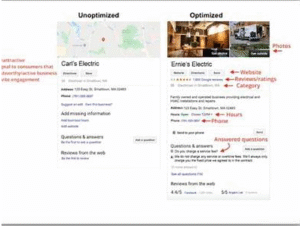
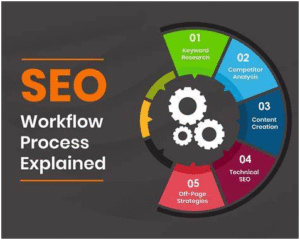
NAP consistency is the foundation — but it’s not the only ingredient in a robust local SEO strategy. To truly dominate in 2026, you’ll want to layer additional tactics on top of a clean NAP foundation:
- Optimize Your Google Business Profile (GBP)
- Ensure all relevant fields are completed (categories, business description, hours, services, photos, etc.).
- Use the canonical NAP in the GBP.
- Add high-quality photos, regular posts, and encourage customer reviews.
Having a fully optimized GBP with consistent NAP helps reinforce trust and prominence. Many businesses make the mistake of treating GBP as “set it and forget it” — but treating it as a living asset yields better long-term value.
- Use Structured Data (Schema Markup)
Implement structured data — e.g., the LocalBusiness schema — on your website’s homepage and contact page. Include name, address, phone, business hours, and geo-coordinates (if possible).
Structured data helps search engines interpret your business info reliably regardless of directory formatting; it makes your NAP “crawl-friendly” and machine-readable.
- Collect & Consolidate Reviews / Social Proof
Clean NAP ensures that reviews on different platforms (Yelp, GBP, niche directories) are more likely to aggregate properly under a single listing. That amplifies your prominence signal.
- Link Building & Local Content Strategy
Once your NAP is consistent and your listing ecosystem is clean, content marketing and link building (e.g., guest posts, local PR, collaborations) become more effective. Citations and backlinks will refer to a unified entity — maximizing their SEO value rather than fragmenting it.
- Preparing for the Next Frontier: Voice, AI, and Predictive Search
The local search landscape is accelerating — and 2026 is well into the era where voice search, AI assistants, augmented reality maps, and predictive “near me” queries are ubiquitous. In this new landscape, NAP consistency becomes even more critical.
- Voice search & digital assistants: When someone says “Hey Google — find a bakery near me,” the assistant relies heavily on structured, consistent NAP data aggregated across platforms to present accurate, trustworthy results. Inconsistent or conflicting data can cause your business to be skipped or mis-represented.
- AI & predictive search: As search engines get smarter, they stitch together data from multiple sources — websites, directories, review sites, social profiles — to build a unified business profile. If those sources are inconsistent, AI may disregard parts or treat them as separate entities. Robust NAP helps ensure your “digital footprint” is cohesive and authoritative.
- AR / Map-based discovery: As augmented reality navigation and map overlays become more common (especially in high-density urban or retail areas), having accurate, consistent address data ensures your business pin lands correctly — avoiding misplacement that could hurt foot traffic and conversions.
In short — moving forward, NAP consistency isn’t just a legacy SEO tactic. It’s the foundation for future-proof local visibility in an AI- and data-driven world.
- Realistic 2026 Case Studies & Before/After Scenarios
Case Study 1 — Single-Location Service Business: “GreenLeaf Landscaping”
Before: GreenLeaf had multiple directory listings — some spelled as “Green Leaf Landscaping,” others as “GreenLeaf Landscaping LLC,” some with an old phone number, and one with an outdated address after they relocated. Their GBP looked good, but many third-party directories were inconsistent or outdated.
After: They ran a full NAP audit, standardized to: “GreenLeaf Landscaping LLC,” new address, primary phone. Updated all directories, website, social profiles. Within 8 weeks:
- GBP “Map Pack” appearances increased by ~45%.
- Phone call inquiries from organic searches increased by ~52%.
- Local search visibility (impressions in Google Maps/Search) rose by ~60%.
Insight: Without any change in content or backlinks — just by cleaning and unifying NAP — they re-established prominence and saw real business growth.
Case Study 2 — Multi-Location Business: “MetroDry Cleaning (3 branches)”
Challenge: With three locations, they had variations — one branch used “MetroDry Cleaners,” another “Metro Dry Cleaning LLC,” and older branches had old phone numbers. Google started merging or suppressing certain listings; reviews were split; customers called wrong numbers.
Solution: Created a master spreadsheet with separate sheets per branch, defined canonical NAP for each, claimed/verified all listings, and standardized across platforms. Assigned the operations manager to quarterly audit each branch’s citations.
Results after 6 months:
- All three branches regained full listing visibility with correct info.
- Review counts and ratings consolidated under each proper location — increasing perceived trust and social proof.
- Combined local search traffic rose ~70%, with consistent increase in calls and in-store visits.
Insight: Scaling NAP management is crucial; having a system and owner makes multi-site SEO growth sustainable and effective.
- Maintenance Best Practices & Organizational Policies
To ensure your NAP consistency remains strong over time — and doesn’t erode as you grow — adopt these ongoing practices:
- Schedule regular audits — quarterly or every 6 months.
- Assign NAP ownership — an internal team member or external service should manage NAP updates.
- Document every change — whenever address, phone, name, business hours, etc., change, update master NAP and propagate across platforms.
- Use central, shared documentation — a Google Sheet, internal wiki, or CRM field that everyone references.
- Leverage automation tools — citation management platforms, alerts for duplicate or inconsistent listings, bulk update capabilities.
- Monitor impact metrics — track GBP impressions, phone call volume, click-throughs, “requests for directions,” website traffic — to measure the ROI of NAP consistency.
- Train staff or vendors — especially for multi-location businesses or franchises, ensure that anyone who manages listings understands the importance of NAP accuracy.
Treat NAP as a living asset, not a “set-it-and-forget-it” task.
- Common Mistakes, Pitfalls & How to Avoid Them
| Mistake / Pitfall | Risk / Consequence | How to Avoid |
| Using different abbreviations (St. vs Street; Rd vs Road) across listings | Fragmented citations; search engines may treat as different businesses | Define canonical format rules and stick to them everywhere |
| Forgetting suite numbers, or inconsistent address line-breaks | Customers get lost; business may not appear correctly on map or GPS | Always include full address (street, suite, city, state, ZIP) in canonical NAP |
| Multiple phone numbers across platforms | Missed calls, lost leads, confusion, split reviews | Use a single primary business number everywhere; use call-tracking carefully if needed |
| Not claiming / verifying directory listings or leaving duplicates live | Suppressed listings, split reviews, lost authority | Claim and verify all major listings; merge or remove duplicates |
| No ongoing monitoring — business moves or phone changes but listings are left outdated | Loss of visibility, incorrect contact info, lost trust | Add NAP updates to company change protocol; assign ongoing ownership |
Understanding these pitfalls and proactively guarding against them keeps your NAP strong — and your local SEO intact.
- Conclusion — NAP Consistency as Your Foundation for Local Domination
In a world where businesses scramble for backlinks, content, keywords, and flashy optimization tactics, it’s easy to overlook the simple, structural elements like NAP consistency. But in local SEO — and especially when you rely on your online presence to drive real-world customers — NAP is your foundation.
If your business fundamentals are inconsistent across the web, everything else you build risks crumbling under scrutiny. On the other hand, a clean, consistent NAP — maintained over time — signals to search engines and users alike that your business is real, legitimate, and ready for business.
In 2026 and beyond, as search becomes more intelligent, more automated, and more dependent on structured data, NAP consistency won’t just be important — it will be non-negotiable. If you want to dominate your local market, win the Map Pack, and build a sustainable stream of leads from search, start here: with NAP.
- Frequently Asked Questions (FAQ)
Q: Is exact formatting (e.g., “St.” vs “Street”) really that important?
A: Yes. While search engines have become smarter over time, many directories and aggregators treat slight variations as different entities. Consistent formatting avoids fragmentation and strengthens your citation footprint.
Q: My business has multiple locations — do I need a separate NAP for each?
A: Yes — treat each location as its own “entity” with its own canonical NAP, audit, and listing set. That ensures clarity, avoids merged/suppressed listings, and maximizes visibility for each location.
Q: Will fixing NAP really move my GBP ranking if I haven’t done anything else (content, backlinks, reviews)?
A: Often, yes. Because NAP consistency supports core signals (proximity, prominence), cleaning up your NAP can yield visibility gains — even without other SEO efforts.
Q: How often should I audit my NAP?
A: At least quarterly. More frequent audits are wise if your business changes addresses, phone numbers, or adds new locations.
Q: What tools should I use to manage NAP at scale?
A: Use citation management tools like BrightLocal, Moz Local (among others) and maintain a centralized NAP document (e.g., spreadsheet or CRM). Use structured data (schema markup) on your website and assign ownership (internal or external) for ongoing oversight.
Final Thoughts
If you’ve skimmed this article expecting new, secret SEO hacks — you may be surprised. NAP consistency isn’t glamorous. It doesn’t guarantee overnight traffic spikes. But it is the foundation on which all other local SEO efforts rest.
In 2026, as Google’s algorithms and AI-driven systems grow more sophisticated, fragmented or inconsistent business data will be penalized harshly. Meanwhile, businesses with clean, consistent, authoritative NAP — tied together by optimized GBP, structured data, reviews, and citations — will be positioned not just to compete — but to dominate.
Treat NAP consistency as your local SEO bedrock. Clean it first. Then build confidently on top.