







Introduction: Why NAP Consistency Should Be Your Foundation
If you’re running a local business — a retail store, a service provider, a clinic, a restaurant — you’ve likely heard about Google Business Profile (GBP) and how important it is for local visibility. But what many business owners and marketers overlook is that beyond reviews, photos, and keywords, a simple factor often makes or breaks your ability to show up in local search results: the consistency of your NAP — Name, Address, Phone number.
In the world of local SEO, NAP consistency acts as the “digital footprint” or “identity anchor” for your business. If Google and other directories see the same business information everywhere, it builds confidence — making your business more likely to appear in search results, maps, and “local pack” rankings. If the details differ even slightly, that can sow doubt. Small variations — “St.” vs “Street,” “Suite 5” vs “#5,” different phone-number formats — may seem trivial to a human, but to search engines, they can signal that those listings refer to different businesses.
This guide will show you why NAP consistency matters, how to audit and fix it, best practices and workflows, and strategic recommendations to make NAP accuracy a foundational part of your local SEO — not a one-time item, but an ongoing habit.
Table of Contents (Suggested Full-Length Guide)
- What Is NAP — and Why It Matters
- How NAP Consistency Impacts Local SEO & Google Business Profile
- Common NAP Inconsistencies and Their Real-World Consequences
- Audit: How to Check Your Current NAP Citations (Manual + Tools)
- Fixing NAP Issues — Step-by-Step Workflow
- Best Practices & Standardization Guidelines
- Tools & Automation for NAP Management
- Ongoing Monitoring, Reporting & Maintenance
- Advanced Considerations: Multi-Location, Franchise, Schema Markup, AI & Voice Search
- Strategic Recommendations & Local SEO Integration
- Case Studies & Hypothetical Examples
- Frequently Asked Questions (FAQ)
- Conclusion & Action Plan
- What Is NAP — and Why It Matters
Defining NAP
- N — Name: The exact business name (e.g., “Smith’s Plumbing Services”, not “Smith Plumbing” or “Smith’s Plumbing Co.”).
- A — Address: The physical (and/or mailing) address: street number, street name, suite or unit number (if applicable), city, state, ZIP/postal code.
- P — Phone Number: A consistent main contact line, formatted uniformly (e.g., “(555) 123-4567” or “+1-555-123-4567”, but always the same format everywhere).
In the context of local SEO, NAP is more than contact info — it’s your business’s unique identifier across the web.
Why It Matters: First Principles
- Search-Engine Trust & Verification — Search engines crawl multiple sources (your website, directories, review platforms, maps) and cross-reference business data. Consistent NAP affirms your legitimacy; inconsistent data raises red flags.
- User Experience & Credibility — Customers expect accurate details. Discrepancies can lead to wrong directions, failed calls, or general mistrust. Consistency improves customer trust and user satisfaction.
- Local Search & “Map Pack” Visibility — Local search algorithms (including those of Google) rely on relevance, distance, and prominence; consistent NAP supports prominence and helps your eligibility for local pack results.
- Structured Data & Future-Proofing — As search evolves (voice search, AI-driven local discovery, generative search), structured, accurate business data becomes even more critical. Inconsistent NAP can hinder visibility when systems rely on clean data.
In short — NAP consistency is not optional. It’s foundational. Without it, all other local SEO efforts (reviews, content, backlinks) are built on shaky ground.
- How NAP Consistency Impacts Local SEO & Google Business Profile
The Role of Citations in Local SEO
A citation is any mention of your business’s NAP on the web — structured (directory listing) or unstructured (blog post, news article, social media).
Search engines treat high-quality, consistent citations as strong evidence that your business is real, active, and stable. The more consistent and authoritative these citations are, the better your chances to rank well locally.
Google Business Profile (GBP) & the Local Pack
Your GBP listing is your “master record” — the single most important citation. When Google sees matching NAP across GBP and other sources, it’s far more likely to display your business in the local pack or on maps.
Conversely: If variations exist — even minor ones — Google’s algorithms may treat those as signals of multiple, conflicting entities, reducing the odds that they will rank your business well.
Impact on Key Local SEO Metrics
- Visibility in Local SERPs: More consistent citations = higher trust = better placement.
- Map Pack Inclusion: Accurate NAP improves your eligibility to appear in the coveted “Local 3-Pack” or map results.
- Customer Conversions (Calls, Visits): When people see consistent, accurate info they are more likely to call or visit — boosting real business results.
- Long-Term Local Authority: Over time, consistent citations accumulate, increasing “prominence” and making your business a stable presence in the local ecosystem.
- Common NAP Inconsistencies and Their Real-World Consequences
Even businesses that try to “do SEO” often end up with messy NAP data — here are some of the most common culprits, and why they matter.
Frequent NAP Mistakes
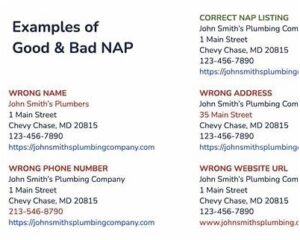
- Name variations: e.g., “Smith Plumbing Services” vs. “Smith Plumbing Co.” vs. “Smith’s Plumbing.” Slight name changes can confuse search engines.
- Address formatting differences: “St.” vs “Street,” “Rd.” vs “Road,” or “Suite 5” vs “#5” — all minor to a human, but potentially different to an algorithm.
- Phone number formatting differences: Missing country code, different separators (spaces, dashes, parentheses), or inconsistent use of main vs. secondary numbers.
- Outdated or duplicate listings: Old addresses (after relocation), closed or merged locations, or multiple entries for the same business.
- Partial or missing data: Some directories list only name and address but omit phone, or vice versa — making that citation weaker or ambiguous.
Real Consequences for Businesses
- Lower Local Rankings: Inconsistent data weakens trust signals → your business may rank lower or not appear in the Local Pack.
- Lost Customers: Inaccurate phone numbers or addresses = missed calls, wrong directions, lost foot traffic.
- Reduced Conversion and Reputation Damage: Inconsistencies may appear unprofessional or spammy, undermining customer confidence.
- Wasted SEO Effort: Even if you build reviews, create content, or acquire backlinks — they may bring limited benefit if the foundational data is unreliable.
In short — NAP inconsistencies don’t just produce mild annoyance; they can actively tank your local search performance, conversions, and credibility.
- Audit: How to Check Your Current NAP Citations (Manual + Tools)
Before you can fix NAP issues, you need to know where they exist. A proper audit gives you a “snapshot” of your current state. You can do this manually, or use tools for efficiency.

Manual Audit — Step by Step
- Define Your Master NAP
Choose the authoritative format for your business as it should appear everywhere — on your website, directory listings, contact page, etc. Document it exactly (spellings, abbreviations, punctuation, suite numbers, phone format). - Search Your Business Name in Quotes
On Google (or other engines), search “Your Business Name” — in quotes — to force exact-match results. This helps you find all instances where your business is mentioned. - Visit Each Result — Record NAP Info
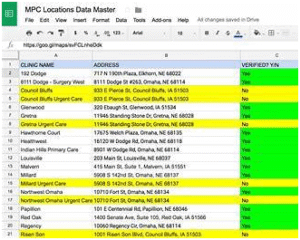
For each listing (directories, social profiles, local blogs, review sites), record exactly how the name, address, and phone are listed. Many businesses make the mistake of ignoring directories like YellowPages, niche industry directories, or older blog posts. - Create a Spreadsheet / Audit Table
Structure columns as: Platform / Directory | Name (as listed) | Address | Phone | Notes (Mismatch? Missing? Duplicate?) — this gives you a single view of everything. - Prioritize High-Authority / High-Impact Listings
At minimum, audit: your website (home page and contact/footer), Google Business Profile, major directories (Yelp, Bing Places, Facebook, industry directories), review sites, and any high-traffic local blogs or news sites that mention you.
Tools to Automate or Simplify Audits
While manual audits are thorough, they’re time-consuming. Several tools can help:
- BrightLocal — citation tracker and audit tools. Scans many directories and highlights inconsistencies.
- Moz Local — helps identify existing listings and duplicates; aids cleanup and standardization.
- Yext (or similar listing-management platforms) — allow you to manage, update, and push NAP edits across many directories at once.
- Other Citation Tools — local SEO agencies often use proprietary or niche directory-scanning tools to catch mentions missed by mainstream tools.
Output: What Your Audit Should Tell You
- Where your citations are correct and consistent.
- Where discrepancies exist (name, address, phone mismatches).
- Duplicate listings that may need consolidation.
- Missing citations (i.e., directories where your business should be listed but isn’t).
- A prioritized “to-fix” list, ordered by impact (high-authority directories first).
With this audit completed, you have both a baseline and a roadmap for cleanup — which leads us to the next major step.
- Fixing NAP Issues — Step-by-Step Workflow
Once you know where the problems are, a methodical cleanup process ensures your master NAP gets propagated everywhere — no mistakes, no lingering duplicates.
Step 1: Decide Your Master NAP Format (and Stick To It)
- Choose exactly how your business name should appear (capitalization, punctuation, abbreviations). Example: “Smith’s Plumbing Services” — not “Smith Plumbing Co.”
- Define your address format: street name and suffix spelling (“Street” vs “St.”), suite/unit formatting (“Suite 5” vs “#5”), city, state, ZIP, etc.
- Choose a phone-number format (with or without country code, using dashes/periods/spaces consistently).
Consider making a simple document (e.g., a Google Doc or Sheets) that states:
Master NAP
Name: __________
Address: __________
Phone: __________
Whenever you update or create new listings, refer back to this document.
Step 2: Claim / Verify Foundational Listings
Your most important listings deserve your control. Ensure you have claimed and verified them:
- Google Business Profile (very often — your GBP listing acts as the “master record” for Google).
- Major platforms: Yelp, Bing Places (if you care about Bing), Facebook (if you have a social presence), industry-specific directories.
- Your own website (with NAP clearly on contact page/footer).
Claiming and verifying gives you the ability to edit — which is critical when outdated or incorrect info exists.
Step 3: Update & Standardize NAP on High-Authority Directories
Using your master NAP, update each listing to match exactly. This includes: name, address, phone formatting — everything. Case, punctuation, suite number, abbreviations — must match.
If you can’t edit some listings (e.g., unclaimed or locked), look for “Suggest edit,” “Claim business,” or contact support to request changes. Update one directory at a time, and track changes in your audit spreadsheet.
Step 4: Merge or Remove Duplicate / Conflicting Listings
If the audit uncovered duplicate listings (same or similar NAP but different entries), take steps to merge or delete them (depending on the platform’s capabilities). Duplicate entries dilute citation value and can confuse search engines. Small Business SEO+2WP Maps+2
Step 5: Add Missing Citations (Directories You Should Be In but Aren’t)
Based on your audit, you might discover directories or local listing sites where your business should be present but isn’t. Add your master NAP citation — especially in authoritative and relevant local or industry-specific directories.
Step 6: Document and Log Your Work; Set Dates
In your audit spreadsheet, mark what you’ve updated, when, and on which platforms. This helps you keep track — especially for large businesses or those with many listings.
Step 7: Periodic Reviews & Ongoing Maintenance
NAP cleanup is not a “set it and forget it” task. Plan to re-audit every 3–6 months (or more frequently if your business moves, changes phone number, or expands). Minor discrepancies often creep up over time due to platform updates, user edits, or old data resurfacing.
- Best Practices & Standardization Guidelines
Creating and maintaining NAP consistency is easier when you follow a set of rules. Here are best-practice guidelines many local SEO experts recommend:

Standardization Tips
- Pick a single canonical name — and use it exactly (same capitalization, punctuation, wording). Don’t vary.
- Write out street suffixes consistently — choose “Street” or “St.” (but don’t mix), “Road” or “Rd.”, “Avenue” or “Ave.” etc.
- Use consistent unit/suite notation — “Suite 5” vs “#5” vs “Ste 5” should always be the same across listings.
- Phone number formatting — pick a format (with country code or without, hyphens/spaces) and always use that. Use the main business line (not separate department numbers) where possible.
- Avoid “keyword stuffing” in business name — Resist the urge to stuff keywords into your business name (e.g., “Best Plumber Detroit – Smith’s Plumbing Services”). Google guidelines discourage this. Instead, use proper business name in NAP, and leverage description, services, and categories for keywords.
- Add NAP to your website’s contact page and footer — ensure all major touchpoints (website, header/footer, contact page) reflect your master NAP. This helps search engine crawlers verify consistency. CallRail+2SeeResponse+2
- Use structured data (Schema) when possible — implement local business schema markup (with NAP info) on your website to give search engines machine-readable data. This helps especially with voice search, AI-driven discovery, and future SEO. Many local-SEO guides recommend pairing NAP consistency with schema. Digital Verto+1
Organizational / Process Tips
- Create a NAP master document — store in a shared location (e.g., Google Drive) so all team members have access.
- Audit quarterly or biannually — set recurring calendar reminders.
- Assign ownership/responsibility — have a single person or team responsible for NAP updates and audits (especially if you have multiple locations).
- Log every change — date, platform, exact change. Helps with future audits or tracking accidental edits.
- Avoid using third-party listings services without oversight — if you hire an agency or directory-submission service, make sure they use your master NAP — not variants.
- Tools & Automation for NAP Management
Manually updating dozens—or hundreds—of directories can quickly become overwhelming. That’s why many businesses and agencies rely on tools and software to manage NAP consistency at scale. Here are top categories and recommendations.
Recommended Tools & Platforms
| Tool / Platform | What It Does / Strength | Best For / Notes |
| BrightLocal | Citation tracker and audit — scans many directories, flags NAP inconsistencies. | Small to medium businesses doing periodic audits. |
| Moz Local | Listing management, duplicate detection, citation building. | Businesses that want to standardize and manage citations systematically. |
| Yext | Centralized dashboard to push updates to many directories at once. | Multi-location businesses, franchises, agencies managing many clients. |
| Citation Agencies / Services | For businesses lacking time or expertise, agencies can manage NAP, clean up duplicates, and standardize listings. | Larger local businesses, or those unwilling/unable to handle manually. |
Tip: Even when using tools or agencies, maintain your own master NAP document and periodically verify listings — automation helps, but human review remains important.
- Ongoing Monitoring, Reporting & Maintenance
Consistency is not a one-time check — it’s a continuous process. Listings can change due to platform updates, user edits, mergers/acquisitions, or even simple errors.
Suggested Ongoing Maintenance Workflow
- Quarterly audits — using your audit spreadsheet or a tool like BrightLocal.
- Log and track changes — keep track of what was updated, when, and by whom.
- Set up alerts or monitoring hooks — some listing tools notify you when your profile changes (or duplicates are created).
- Re-verify critical listings (GBP, Yelp, major directories) — ensure they remain claimed and under your control.
- Update immediately after business changes — any change in address, phone, business name, or suite/unit number should trigger a full NAP sync.
- Periodically scan unstructured citations — local blogs, news articles, partner websites — ensure they reflect correct info (or contact them to request corrections).
Regular maintenance helps prevent drift over time and ensures that your business remains discoverable, credible, and easy to contact — which benefits both SEO and customer experience.
- Advanced Considerations
For many businesses, especially those with multiple locations or brands, basic NAP consistency is just the start. To take full advantage of local SEO, there are advanced topics worth understanding.


Multi-Location & Franchise Businesses
If your business has multiple physical locations (e.g., a chain of stores), you must treat each location as a separate “entity” — each with its own precise NAP, directory listings, and management processes.
- Create a master NAP spreadsheet listing each location separately.
- Ensure each location has a unique GBP listing, own citations, and accurate schema.
- Avoid “mixing” NAP between locations (e.g., listing one location’s phone number on another).
- Audit and update each location separately — this often means more complexity and more frequent checks.
Schema Markup & Structured Data
Adding structured data (e.g., using JSON-LD or Microdata with LocalBusiness schema) to your website provides machine-readable NAP, which helps search engines and voice-search / AI systems interpret your data correctly. Many local SEO experts recommend coupling NAP consistency with schema markup for best results.
Voice Search, AI, and the Future of Local Search
As voice assistants and generative search agents become more common, accurate NAP data will matter even more. AI-driven search — especially localized voice queries — often depends on structured, consistent data to surface results. Inaccurate or inconsistent NAP could mean being “invisible” to new search paradigms.
Citation Quality vs Quantity: Why Quality Matters More
It’s not just about having dozens of directory listings — what matters is how authoritative and consistent they are. High-quality, relevant, and authoritative citations (with consistent NAP) outweigh hundreds of low-value, inconsistent directories.
- Strategic Recommendations & Local SEO Integration
Here’s how you can embed NAP consistency into a broader local SEO strategy — treating it not as a “one-off fix,” but as a strategic foundation.
- Make NAP consistency part of your onboarding process.
Whenever you create a new location, website, or directory listing — start with your master NAP template. - Combine NAP efforts with reviews & reputation management.
Trust signals build over time. NAP + consistent reviews + good ratings = stronger local authority. - Use NAP consistency as part of content and local-link strategy.
When guest posting or contributing to local blogs, always ensure your byline or author bio uses your canonical NAP. - Monitor competitors — learn from their citation footprint.
Tools like BrightLocal or similar let you see where competitors are listed. If they have stable, authoritative citations, aim to match or beat them. - Schedule regular audits & updates.
As discussed, plan for quarterly or semi-annual reviews; tie them into your marketing calendar. - Educate staff or external partners.
If multiple people or agencies manage your online presence — ensure everyone knows and uses the master NAP. - Layer other SEO signals on top of NAP.
Schema markup, quality backlinks, onsite content, mobile optimization, reviews — combine with NAP consistency for maximum effect.
- Case Studies & Hypothetical Examples
Here are a few illustrative — hypothetical — scenarios that show how NAP consistency (or inconsistency) plays out in real life.
Example A — The “Invisible” Café
- Scenario: A small café, “Sunrise Coffee House,” has a GBP listing. On Yelp, it’s listed as “Sunrise Coffeehouse.” On local directory, the address is “123 Main St.”, while GBP shows “123 Main Street.” Phone numbers differ: “(555) 123-4567” vs “5551234567.”
- Result: Despite good reviews and a solid website, the café rarely appears in local searches or map pack results. New customers struggle to find it due to inconsistent info.
- Fix: After auditing and standardizing NAP across all listings (including updating Yelp and local directories), within several weeks search visibility improves, map impressions increase, and foot traffic goes up.
Example B — Multi-Location Renovation Contractor
- Scenario: “Elite Home Renovations” has 5 locations across different suburbs. Over time, staff used inconsistent naming: “Elite Renovations,” “Elite Home Reno,” “Elite Home Renovations – Detroit,” etc. Addresses had variation (suite numbers missing on some, city abbreviations shorthand on others).
- Result: Google and directories treated each listing as separate, diluting citation power. Some locations didn’t even appear in local search results for relevant queries.
- Fix: A comprehensive audit, new master-NAP spreadsheet, standardized naming and formatting across all listings, proper GBP for each location — visibility improved across all markets. The business saw more leads, calls, and site visits.
These examples illustrate how small details — easily overlooked — can have outsized impact on real business results.
- Frequently Asked Questions (FAQ)
Q: How often should I audit my NAP citations?
A: A good rule of thumb is every 3 to 6 months, or immediately after any change (address change, phone number update, relocation, rebranding, new branch, etc.)
Q: Is NAP consistency really that important — or is content & backlinks more important for local SEO?
A: It absolutely matters. While content, backlinks, and reviews remain vital, NAP consistency is foundational — without it, those efforts may not reach full potential. Many expert guides call NAP one of the core “table-stakes” for local SEO.
Q: If I change my business name or move location, what’s the process?
A: Update your master NAP. Then, immediately claim and update your GBP listing, push changes to all major directories, update your website, and perform a full citation audit to fix outdated references.
Q: What if I can’t claim or edit a directory listing (e.g., old unclaimed listing)?
A: Try “Suggest an edit,” contact support, or if the site allows, submit a request for correction. Use your audit sheet to track these pending changes.
Q: Do I need to worry about “unstructured citations” (blogs, news articles, social media)?
A: Yes — while structured directories are more important, unstructured citations add legitimacy and breadth. If possible, request updates or corrections where NAP is wrong; for new mentions, ensure correct NAP gets used.
- Conclusion & Action Plan
NAP consistency may seem simple — just your business name, phone, address — but its impact on local SEO, visibility, and user trust is profound. It’s a foundational signal that underpins everything from local search ranking to customer conversions.
If you’re serious about dominating local search and appearing in the map pack, you can’t treat NAP consistency as a “nice-to-have.” It needs to be a core, ongoing part of your marketing process.
10-Step Action Plan for You (Start Today)
- Create your master NAP document (name, address, phone).
- Claim and verify your Google Business Profile (GBP) listing.
- Build an audit spreadsheet and scan all existing listings (manual + tools).
- Identify inconsistencies, duplicates, missing citations.
- Update and standardize NAP on high-authority directories (Yelp, Bing, Facebook, relevant directories).
- Merge or delete duplicate/conflicting listings.
- Add missing citations in authoritative directories.
- Add NAP to your website (footer/contact page) and implement schema markup.
- Schedule recurring quarterly audits to catch drift.
- Embed NAP-consistency policy in onboarding for any new location, directory, or listing.
By following these steps, you’ll build a solid foundation — one that maximizes the value of every other local SEO effort you make (reviews, content, backlinks), and helps ensure your business remains visible, trustworthy, and easy to find.