





Table of Contents
- Introduction — Why NAP Still Matters in 2025
- What Is NAP (Name, Address, Phone) — And What “Consistency” Really Means
- Why Inconsistent NAP Hurts Local SEO & Local Traffic
- SEO / Algorithmic Impact
- User Experience & Credibility Impact
- Citation Dilution & Duplicate Listings
- Real-World Cost: What Businesses Lose When NAP Is Inconsistent
- Missed Google Map Pack Rankings / “Near Me” Searches
- Lost Leads, Lost Customers
- Broken Attribution & Analytics Issues
- Long-term Brand & Trust Damage
- How to Audit Your NAP — Step-by-Step Workflow
- Manual Audit (DIY)
- Using Tools & Automation
- Maintaining a “Master NAP” Reference
- How to Fix Inconsistent NAP — Best Practices and Strategic Workflow
- Standardizing NAP Format (Name, Address, Phone)
- Correcting & Claiming Listings on Major Platforms
- Using Structured Data / Schema Markup on Your Website
- Ongoing Monitoring & Quarterly Audits
- For Multi-location / Franchise Businesses — How to Scale NAP Consistency
- Tools and Services That Help with NAP / Citation Management
- Common Pitfalls, Mistakes & How to Avoid Them
- Going Beyond NAP: Integrating with Broader Local SEO Strategy
- Future-Proofing: Why Clean NAP Matters Even More in the Age of AI, Voice Search & Predictive Search
- Conclusion — Treat NAP as Foundation, Not Afterthought
- FAQ / Quick Reference
- Introduction — Why NAP Still Matters in 2025
In the constantly shifting world of SEO, with new ranking signals, machine learning updates, and evolving user behavior, some foundational practices still hold tremendous weight. Among them is the humble — yet often overlooked — matter of NAP consistency: keeping your business Name, Address, and Phone number exactly the same across the web.
Even in 2025, when algorithms are far more sophisticated than a decade ago, search engines (and especially local search platforms) still rely on NAP as a primary trust signal to verify a business’s legitimacy and location.
Think of NAP as the “digital storefront address plate” of your business. If that plate has the wrong house number, the wrong street name, or a mismatched business name on different directories — potential customers and search engines alike get confused. The result: lost traffic, fewer calls, missed walk-ins, and a fractured online presence that’s much harder to fix long-term.
In this article, we’ll dive deep into how inconsistent NAP can sabotage local SEO and local traffic — even if you have great reviews, a beautiful website, or run ads. I’ll also show you exactly how to audit, fix, and maintain clean NAP data across the web — so you don’t lose any more opportunities.
- What Is NAP (Name, Address, Phone) — And What “Consistency” Really Means
Before we get into why NAP matters (and how it can hurt you when inconsistent), let’s define precisely what we mean by “NAP” — and what “consistent” looks like in practice.
- Name — The official, exact business name as you want it represented online. For example: “Main Street Café, LLC,” or “Joe’s Plumbing — Detroit” — whatever matches your storefront signage, legal paperwork, or branding.
- Address — The complete physical address, including suite numbers or unit numbers, city, state, ZIP/postal code, and any relevant local naming (e.g., “Ste.” vs “Suite”).
- Phone number — The primary contact number for the business; ideally formatted consistently (e.g., “(810) 555-1234” or “+1-810-555-1234”), and including area code, country code if relevant.
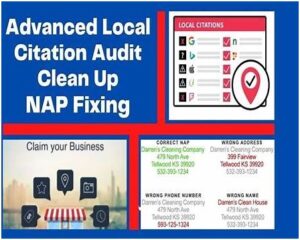
But “consistency” doesn’t only mean correctness — it means identical representation everywhere. Even seemingly minor variations — “St.” vs “Street”, “Suite” vs “Ste.”, “LLC” at the end of your name — can confuse search engines and split your business’s digital footprint.
A truly consistent NAP means that whether a customer visits your website, checks your listing on Google, sees you on Yelp, browses a local directory, or finds a chamber of commerce mention — the Name, Address, and Phone number are exactly the same.
As one guide puts it: even small formatting differences (e.g., “St.” vs “Street”) can confuse search engines and dilute your citation power.
That uniformity across all platforms is what we refer to as NAP consistency.
- Why Inconsistent NAP Hurts Local SEO & Local Traffic
If you think NAP is “just data entry,” you’re not alone — but that underestimates how important it is. Here’s what happens when your NAP is inconsistent:
SEO / Algorithmic Impact
- Search Engines Doubt Legitimacy & Location
Search engines use NAP as a key signal to verify that a business is real, stable, and tied to a physical location. When they find conflicting information — e.g., different addresses or phone numbers across different directories — it undermines that signal. - Your Citations are Diluted or Fragmented
Each distinct version of your business (slightly different name or address) may be treated as a separate listing or entity. Instead of many consistent citations reinforcing one business profile, you end up with fractured authority spread across variants — reducing the cumulative SEO benefit. - Lower Chance to Rank in Local “Map Pack” / Local Pack
Local search — especially “near me” searches — relies heavily on trust and location signals. Inconsistent NAP diminishes those signals, weakening your chance of appearing in the coveted top 3 local results (Map Pack). - Duplicate / Conflicting Listings — Bad for Algorithmic Trust
Inconsistencies can cause duplicate listings which may split reviews, click-throughs, and other engagement metrics. Search engines may penalize or ignore conflicting listings, hurting overall visibility.
User Experience & Credibility Impact
Even if your SEO weren’t at stake — having inconsistent NAP data across directories can seriously damage your trust with potential customers:
- Customers Get Confused or Frustrated
If a user sees one phone number on Google, another on Yelp, and yet another on your website — they may hesitate to call, or assume the business is closed, outdated, or not trustworthy. - Incorrect Address or Phone Means Lost Leads
A wrong address might send people to the wrong place; a wrong phone number might mean missed calls. That’s lost revenue directly — and perhaps permanently, if the customer moves on to a competitor. - Brand Image & Professionalism Suffers
Professionalism begins with attention to detail. Inconsistent NAP suggests neglect or sloppiness, which can erode confidence in your brand — especially harmful for service-oriented local businesses (plumbers, dentists, boutiques, etc.).
Citation Dilution & Duplicate Listings
Consistent citations are a fundamental building block of local SEO. When your NAP is messy:
- Some citations may not be counted correctly by search engines.
- Reviews or user-generated content may split across duplicates, reducing social proof on any one listing.
- The more conflicting versions out there, the harder it becomes to clean up — once inconsistencies propagate.
In short: NAP inconsistency weakens the foundation of your local SEO — and everything built on top of that foundation (reviews, keyword-optimized content, Google Business Profile, local link building) becomes less effective.
- Real-World Cost: What Businesses Lose When NAP Is Inconsistent
It’s one thing to talk about visibility or rankings in abstract, but real businesses lose real money and opportunity when NAP is inconsistent. Here are the tangible—and often substantial—downsides.
Missed Google Map Pack Rankings / “Near Me” Searches
Local users increasingly rely on “near me” + “open now” queries — especially on mobile. According to many local SEO experts and citation analyses, NAP consistency remains one of the top 5 foundational factors that influences whether a business will appear in Map Pack results.
If your NAP is inconsistent, you may completely miss out on Map Pack placements — so even if people in your area search for your service or product, they might never see you. That’s a huge slice of potential traffic gone.
Lost Leads, Lost Customers
Because of misleading or broken contact information:
- Calls might go to the wrong number (or to nobody).
- Customers might drive to the wrong address.
- Potential clients may assume your business is unprofessional — and move on.
For a local business, each lost call or wrong-address visit can translate directly into lost revenue, sometimes repeatedly, before they even know what went wrong.
Broken Attribution & Analytics Issues
If you’re running ads, promotions, or tracking leads, inconsistent NAP can break your analytics. You might not be able to attribute calls or visits correctly — because some come through a variant of your listing, not the canonical one.
This makes it harder to measure performance, optimize marketing spend, or understand which channels are producing real ROI.
Long-Term Brand & Trust Damage
Over time, messy NAP builds a patchy online footprint. Reviews get scattered, brand mentions spread across multiple variants — which dilutes brand identity.
If a potential customer sees different business names or addresses on various platforms, their confidence drops. For service-based businesses (e.g. legal firms, plumbers, medical practices), this kind of inconsistency can be especially harmful.
- How to Audit Your NAP — Step-by-Step Workflow
If you suspect your NAP may be inconsistent (or you just want to be sure), here’s a workflow to audit — both manually, and with the help of tools.
Manual Audit (DIY)
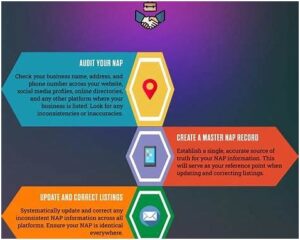
- Pick your canonical NAP format
- Choose the exact business name (e.g. “Acme Plumbing, LLC”).
- Write the full physical address, including suite number (if any).
- Choose a consistent phone format (e.g. (810) 555-1234 or +1-810-555-1234).
- Create a simple spreadsheet — with columns such as: Platform / Directory, Name listed, Address listed, Phone listed, Notes.
- Search for variants of your business in Google (in quotes)
- Example: “Acme Plumbing LLC Detroit” or “Acme Plumbing Detroit MI” — this forces results to match exact string.
- Visit major listing platforms — your website, your listing on Google (Google Business Profile / GMB), social profiles (Facebook, LinkedIn), and broader directories (Yelp, YellowPages, Bing Places, local directories, Chamber of Commerce, etc.).
- Compare each listing’s NAP to your master reference — mark all discrepancies in the spreadsheet.
- Look also for duplicates — sometimes businesses end up with multiple listings (slightly different name, different address formatting, etc.). Note them for cleanup.
Using Tools & Automation
Doing it manually can work — but it’s time-consuming, and easy to miss obscure directories or hidden citations. That’s where audit tools come in. Several services can crawl dozens or hundreds of directories and flag NAP mismatches or duplicate citations. Examples include widely used local-SEO platforms.
Advantages of using tools:
- They scan many directories — national, regional, niche — faster than you could manually.
- They track changes over time — so if a listing changes (e.g., after a rebrand), you get alerted.
- Some allow bulk updates or tie all corrections to a central dashboard — which is especially useful if you manage multiple locations.
Maintaining a “Master NAP” Reference
Once you finish your audit and reconcile discrepancies — store the correct NAP in a central reference document (e.g., a “NAP style guide”). Whenever a listing needs editing — that style guide becomes your single source of truth.
This helps prevent future drift (e.g., someone abbreviating “Suite” as “Ste.” on one directory but not another), and keeps your NAP consistent indefinitely.
- How to Fix Inconsistent NAP — Best Practices and Strategic Workflow
Auditing is half the battle. The real work comes in fixing inconsistencies — and keeping things clean going forward. Below is a strategic workflow and best practices.
6.1 Standardizing NAP Format
- Set your canonical business name — pick the exact legal/brand name, including punctuation, LLC/incorporation tags, abbreviations, etc.
- Agree on address formatting: decide whether to use abbreviations like “St.” vs “Street”, “Ste.” vs “Suite”, inclusion of unit numbers, punctuation, commas, etc.
- Choose one phone format — with or without country code; use hyphens, spaces, or parentheses consistently.
- Document all this in a “NAP Style Guide” — share it with everyone on your marketing/operations team so new listings or changes follow the standard.
6.2 Claiming & Correcting Listings on Major Platforms
Start with high-priority, high-authority platforms — because they carry the most weight for local SEO and are most visible to users.
- Google Business Profile (GMB) — your “master listing.” Ensure name, address, phone number exactly match your canonical NAP.
- Social profiles — Facebook, LinkedIn, Instagram, etc. — update contact info and “About”/“Contact” sections.
- High-traffic directories — Yelp, YellowPages, Bing Places (if relevant), major local directories in your region or industry.
- Niche / industry-specific directories — any directory relevant to your niche, trade, or local community (e.g., chamber of commerce, local business associations).
- Chamber / Government / Licensing directories (if applicable) — if you have business licenses, ensure they also reflect the correct official name/address.
For each platform: claim the listing (if not already done), or submit updates. Make sure changes propagate properly.
6.3 Use Structured Data / Schema Markup on Your Website
On your website (especially your homepage, contact page, footer) embed structured data (e.g., JSON-LD) that includes your NAP. This helps search engines parse and verify your business info more reliably. Many local SEO guides recommend this as part of a comprehensive NAP / local SEO strategy.
Including NAP in structured data ensures your website becomes a strong, trustworthy reference — against which other directories can be compared.
6.4 Ongoing Monitoring & Quarterly Audits
- Schedule regular audits — e.g., once per quarter — using your spreadsheet or a citation-management tool.
- Update the “NAP Style Guide” if your business details change (address, phone number, name) — and push the change across all listings.
- Log all changes: keep a history of updates, which directories you updated, when, and what changed. This helps avoid drift and duplication over time.
6.5 For Multi-location / Franchise Businesses — Scaling NAP Consistency
- Maintain a master file (spreadsheet/dashboard) listing all locations, each with its canonical NAP.
- Assign clear roles — who at HQ is responsible for updating listings when a new location opens or business info changes.
- Use a centralized directory management tool (see section below) — so you can push bulk updates and maintain consistent formatting automatically across many locations.
- Periodically audit at both the local (per location) and global (brand-wide) level to catch formatting drift, duplicate entries, or outdated info.
- Tools and Services That Help with NAP / Citation Management
While manual audits and updates are possible — they can be time-consuming, error-prone, and difficult to maintain, especially for businesses with multiple locations. That’s why many marketers rely on dedicated tools and services. Here are some of the most useful categories and examples:
| Tool / Service Type | What They Do / Why They Help |
| Citation tracking / audit tools | Crawl hundreds of directories, list all your existing citations, flag inconsistent or duplicate NAPs. |
| Bulk citation management platforms | Allow you to push updates across many directories from a single dashboard — ideal for multi-location businesses. |
| Structured data generators | Help embed accurate NAP schema markup on your site. |
| Listing claim & verification services | Help you claim unverified listings (e.g., old Yelp or Bing entries) to ensure you control them. |
| Ongoing monitoring & alert tools | After you fix everything, these tools watch for future changes (e.g., directories automatically revert your info) and alert you. |
For example, some citation-management tools specialize in consolidating and standardizing NAP across Google, social media, directories, and more — acting as a “single source of truth.” rallio.com+1
Using such tools saves time, reduces human error, and ensures consistency across your full digital footprint.
- Common Pitfalls, Mistakes & How to Avoid Them
Fixing NAP inconsistencies is not just a one-time exercise — many businesses slip back into old habits or introduce new errors. Here are common pitfalls and how to avoid them:
- Using slightly different business names — e.g., including or dropping “LLC,” adding a hyphen, dropping “& Co.”, etc. Even minor name variations split your digital presence. Fix: Always use the canonical name exactly as in your style guide.
- Address formatting differences — e.g., abbreviations (“Rd.” vs “Road”), punctuation differences, missing suite/unit number. Fix: Standardize address format and include all parts consistently.
- Phone number formatting changes — sometimes people add country code, sometimes not; sometimes use dashes, sometimes spaces. Fix: Stick to one format across all citations.
- Old or duplicate listings remain active — you update one directory but a duplicate remains unresolved, meaning confusion persists. Fix: Identify and either consolidate duplicates or mark outdated listings “closed.”
- Neglecting less-popular or niche directories — major platforms may be fixed, but dozens of smaller directories get forgotten, and inconsistent info there still hurts. Fix: Use a tool to audit and sweep across both major and minor directories.
- Failure to update after business changes — when you move, rebrand, change phone number — forgetting to update everywhere leads to inconsistent legacy data. Fix: Make NAP update part of any business change checklist.
- Going Beyond NAP: Integrating with a Broader Local SEO Strategy
While NAP consistency is foundational, it works best when integrated into a broader local SEO strategy. Here’s how to layer it with other elements to maximize impact:
- Google Business Profile (GB P) Optimization — ensuring accurate NAP on GMB, adding high-quality photos, updating business hours, responding to reviews.
- Schema / Structured Data + On-page SEO — embedding NAP, service info, areas served, business categories helps search engines match your business to queries.
- Local Citations & Local Backlinks — combining consistent NAP with genuine local backlinks (e.g., from local blogs, news sites, sponsorships) strengthens your local footprint.
- Content Strategy with Local Focus — blog posts, landing pages targeting local neighborhoods, events — giving search engines more context about where you operate.
- Reviews & Reputation Management — consolidating reviews (across duplicate listings) into a primary location, encouraging more reviews, responding to feedback — all while ensuring NAP stays consistent.
When you treat NAP not as a one-off cleanup item, but as the foundation for a broader local SEO ecosystem — everything else becomes stronger, more coherent, and more effective.
- Future-Proofing: Why Clean NAP Matters Even More in the Age of AI, Voice Search & Predictive Search
We’re not just optimizing for today’s Google results — local search is evolving rapidly. Here’s why NAP consistency is even more critical going forward:
- AI-driven search & voice assistants — as more people use voice search (“Hey Google, find a plumber near me”), search engines rely heavily on structured, consistent data (like NAP) to answer accurately. Inconsistent data increases the risk of being excluded from AI or voice-driven results.
- Predictive search & “near me” suggestions — platforms may pre-emptively show businesses based on location, prior behavior, and structured data. If your NAP is inconsistent or scattered, you’re less likely to be surfaced reliably.
- Growing importance of local-data networks — as directories, apps, and third-party data aggregators exchange information, inconsistent listings have higher chance of causing conflicts or being flagged. Clean NAP becomes a safeguard against data chaos.
In short: NAP consistency isn’t just a 2015–2020 concern. As search becomes smarter, more context-aware, and more reliant on structured data — a consistent NAP becomes more critical than ever.
- Conclusion — Treat NAP as Foundation, Not Afterthought
If there’s one truth I hope you take from this article: NAP consistency is not just a data-entry task — it’s the foundation of your local SEO and local traffic strategy.
Ignoring it, or treating it as a one-time chore, is like building a house on a shaky foundation. You might get some results (good reviews, content, ads) — but everything remains vulnerable to fragmentation, duplicate listings, lost leads, and diminishing returns.
On the flip side — invest in a thorough audit, standardize your NAP once and for all, embed it correctly on your site, claim and correct all major directory listings, and commit to ongoing maintenance — and you’ll unlock a stable, high-integrity local footprint that lets your marketing, content, reviews, and SEO all work together seamlessly.
In a world where “near me” searches, voice assistants, and AI-driven recommendations are increasingly common, clean NAP data isn’t optional: it’s essential.
- FAQ / Quick Reference
Q: What counts as a NAP inconsistency?
A: Any difference — even minor — between how your business name, address, or phone number is listed across directories. For example: “Main St.” vs “Main Street”, “LLC” missing or added, different phone number format, missing suite/unit number, etc.
Q: I updated my website — but old listings remain. Will that hurt me?
A: Yes. Search engines and users may still see the outdated listings. Unless corrected, those old listings continue to fragment your footprint. That’s why an audit of third-party directories and citation sites is necessary.
Q: How often should I audit my NAP?
A: At minimum quarterly. Ideally, whenever you change any business info (address, phone, name), or whenever you add a new location.
Q: Are some platforms more important than others when fixing NAP?
A: Yes. Start with high-authority, high-traffic platforms: Google Business Profile, major directories (Yelp, YellowPages, Bing), social profiles, and any widely used local directories in your industry or region. But don’t ignore niche or smaller directories — search engines often crawl them too, and inconsistencies there can still hurt.
Q: Can I automate NAP management?
A: Yes. Especially if you operate multiple locations, using a citation-management tool or platform with bulk updates can save time, reduce errors, and keep your NAP consistent over time.
Visual & Image Suggestions (for your content production team)
To make this article more engaging and visually rich — and similar in style to the example blogs you provided — here are suggested images / charts you can embed with relevant captions: